 Shea CullenNSW Registered Architect 9748 · Updated 14 August 2026
There is a lot of evidence that natural light is good for your mental health. They have even done studies that show that artificial lighting can help certain mental illnesses when the colour range is as close to natural light as possible (CRI value).
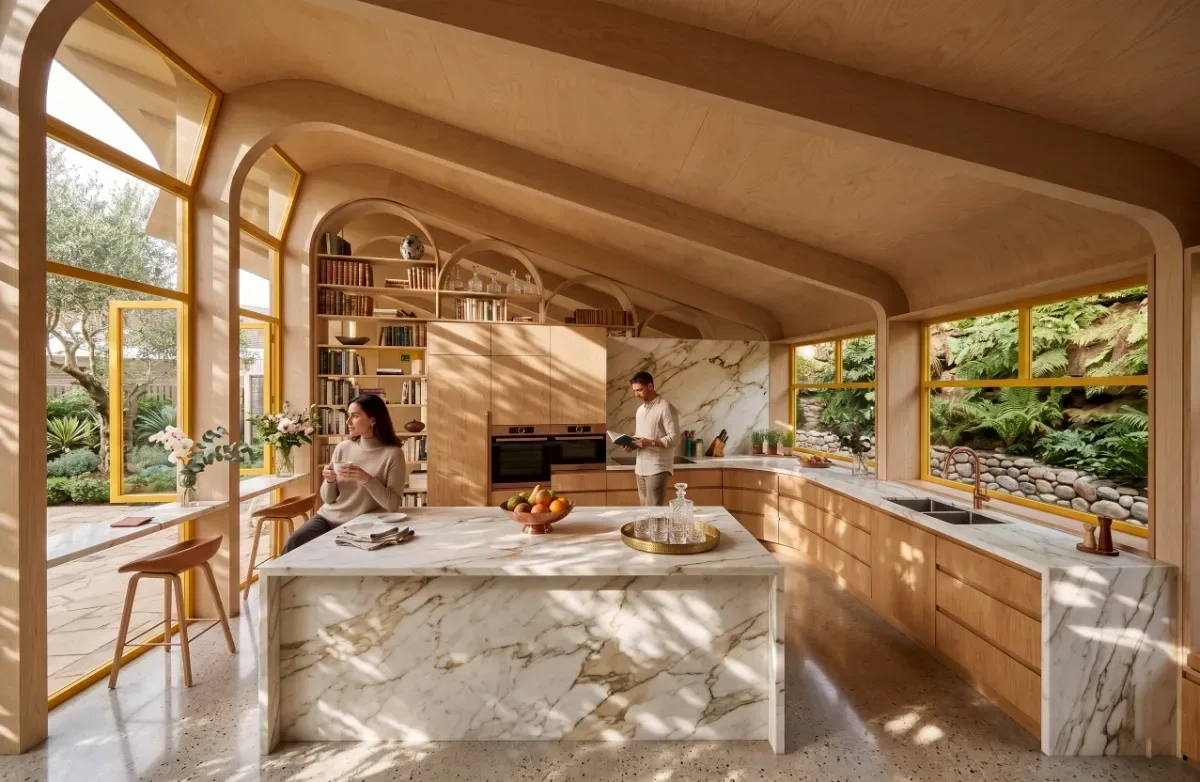
When you are thinking about your home, think about having a lot of natural light through windows and also about specifying the lighting below. Getting natural light into the right rooms at the right time of year is the heart of passive design on the Central Coast, and it starts with orientation. The section below is based on the articles mentioned as well as "Joyful" by Ingrid Fetell Lee, a great read I highly recommend.
Placing Windows
Natural light is the best for you physically and mentally. Having a window within 6m of anywhere in the space you are building. Both natural light and natural ventilation can reach a maximum distance of 6m so this is the critical distance that you need to look at. Thermally windows are the weakest element of your building so make your windows more thermally efficient by looking at this guide to windows.
Lumens
Get 1200 lumens for living areas if you can, the brighter light is better for your eyes and with a high CRI will make everything clearer to see at night.
Specify lighting with a CRI of 95 or higher, ideally CRI 99
The colour range the sun provides is 100 CRI so you want to get as close to that as possible.
Here are some brands that are pretty good:
Waveform Lighting (good quality, needs to come from America though, so check the product is rated for 240V before you order as some of their range is 120V only)
Yuji LEDs (huge range, also an overseas order so check the voltage rating on each product)
Soraa (super high quality for architects and art galleries, now available locally through Australian distributors like Specialist Lighting Distributors and Alti Lighting)
Phillips MAS LED ExpertColor 5.5-50W GU10 930 36D (easiest down light to source in Australia)
Dulora (previously LiquidLEDs, a Sydney family business) has a dedicated ultra high CRI collection at CRI 95 to 97+, dimmable and flicker free (easiest replacement bulbs to source in Australia).
Be careful buying lights from online marketplaces
You will notice the brands above are specialist lighting suppliers, and there is a good reason to stick with them beyond colour quality. In their first Online Marketplace Compliance Exercise (March to April 2026), Lighting Council Australia assessed 131 lighting products being sold to Australian consumers online. More than 73% failed at least one key Australian compliance requirement. Products sampled from Temu and AliExpress had a pass rate of 0%, Amazon 8% and eBay 12%, while specialist lighting suppliers and major lighting retailers passed 80 to 100% of the time.
The most common problem was not a technical fault but a missing supplier: more than 61% of the products came from entities with no registration in Australia's Electrical Equipment Safety System, meaning they had no legal authority to supply electrical equipment here at all. If one of those lights flickers, fails or starts a fire, there is nobody accountable in Australia.
So if a bulb or downlight online looks impossibly cheap, that is often what you are not paying for: testing, certification and a legally accountable supplier. Buy from a specialist lighting supplier or a major Australian lighting retailer, and look for the RCM (Regulatory Compliance Mark) on the product. It matters for the health side of lighting too, because unverified marketplace LEDs are exactly where flicker problems and inflated CRI claims tend to live.
Colour: specify warm light where possible, under 3000k
Here is some guidance when specifying lighting:
• Use lamps that are dimmable and, ideally, colour tuneable*.
• If colour tuneable lamps are not an option, then use warm white lamps (with a rated CCT of no more than 3000 K).*
• Use compatible dimming/tuning lighting controls to avoid problems like flicker from dimmed LEDs. *
• Use lamps with high frequency control gear to avoid flicker effects.*
• Use luminaires with suitable shielding of lamps, preferably with an upward light component and wall washing effects whilst still ensuring sufficient downward component for specific tasks such as kitchen activities.*
• Use lamps with good colour rendering properties* (High CRI)
* Ticleanu C. Impacts of home lighting on human health. Lighting Research & Technology. 2021;53(5):453-475. doi:10.1177/14771535211021064
Lux: get a range between 2500 and 10000
In practice this means get as high a lumens value as you can.
"Exploring the key parameters for indoor light intervention measures in promoting mental health: A systematic review" 2024 by Chunliang Wang et al found that:
"Light illuminance of 2500 to 10000 lux showed significant and positive efficacy"
550nm Colour to simulate daylight
"Exploring the key parameters for indoor light intervention measures in promoting mental health: A systematic review" 2024 by Chunliang Wang et al found that:
"450 to 550 nm range tended to have better therapeutic efficacy than other wavelengths".
A bit of doubt
It should be noted that not every scientific article agrees that CRI has a positive impact.
"Full Spectrum Fluorescent Lighting Effects on People: A Critical Review" 2000 by Jennifer A. Veitch concludes that:
"Despite the efforts of many scientists and the publication of dozens of scientific reports, our knowledge of the effects of lighting on human behaviour, mood, and wellbeing is poor. As regards the effects of light on health and physiology, our understanding is better, but we still do not understand many of the specific mechanisms underlying effects that are known to exist. It is clear from this review that in most areas, the quality of the research is so poor that it is impossible to say definitively whether or not full spectrum fluorescent lighting has any effect on the behaviour or outcome in question. However, the best evidence available points away from differences in spectral characteristics of light sources and towards intensity, variability, flicker, and more complex interactions of people and physical conditions as explanations of the effects of the lit environment on performance, mood, and health."
This study predates the other studies noted by 20 years though, it is good to note that there are variable scientific perspectives on this.