 Shea CullenNSW Registered Architect 9748 · Updated 9 August 2026
Keeping you dry is one of the most basic functions of a building, along with being structurally sound and free of harmful mould. All of it depends on the building staying dry.
Here is the premise the whole approach rests on: a waterproof membrane has a working life of roughly 10 to 15 years, and the building around it is meant to last far longer. So the membrane cannot be the only thing keeping water out. The details below are designed with redundancy, so that when the membrane eventually needs attention, the waterproofing of the building does not fail with it.
Following many failures, both structural and waterproofing, in apartment buildings, the NSW Building Commissioner was appointed to raise the quality of apartment buildings in NSW. The remit has since extended from apartment buildings (Class 2) to boarding houses (Class 3) and aged care buildings (Class 9c). The waterproofing philosophy and details below summarise the Commissioner's two waterproofing courses, which I recommend to every architect, builder and developer:
Let it flow: design a slope so water can flow away
Let it flow is the first of the three design principles. It focuses on directing water away from vulnerable areas rather than trying to block water contact outright. Redirect the water and you heavily reduce the risk of capillary action, seepage and membrane failure.
With adequate falls and drainage, gravity sheds water and stops it pooling. A system that implements let it flow well holds no water anywhere: water keeps moving from the moment it lands until it leaves the building.
Let it work: build layers so one failure is not a leak
The second principle, let it work, is about buildability. Good design usually means finding the simplest solution to a complex problem, because overcomplicated designs are hard to build and more likely to go wrong on site.
Let it work is about creating designs that forgive the variance of real construction. Safety nets in a design let a building absorb the consequences of an error. They account for the imperfect nature of site conditions and for the way buildings move over time. Multilayered drainage systems are the classic example: if one layer is built incorrectly, it does not bring down the whole system.
Let it move: design in the joints, do not pretend the building is static
Let it move accounts for the fact that buildings change over time. Materials respond to temperature, load, moisture and gravity, and they change size and shape as a result. When elements move independently of one another, gaps and cracks open up and water gets in.
Designing a building as a static object guarantees faults in the waterproofing. Fortunately movement is largely predictable. Good design can anticipate how a building will move and use that movement to direct water away from high risk areas and toward drainage. Expansion joints belong in the design, and they need to be waterproofed themselves.
Slab deflection plans
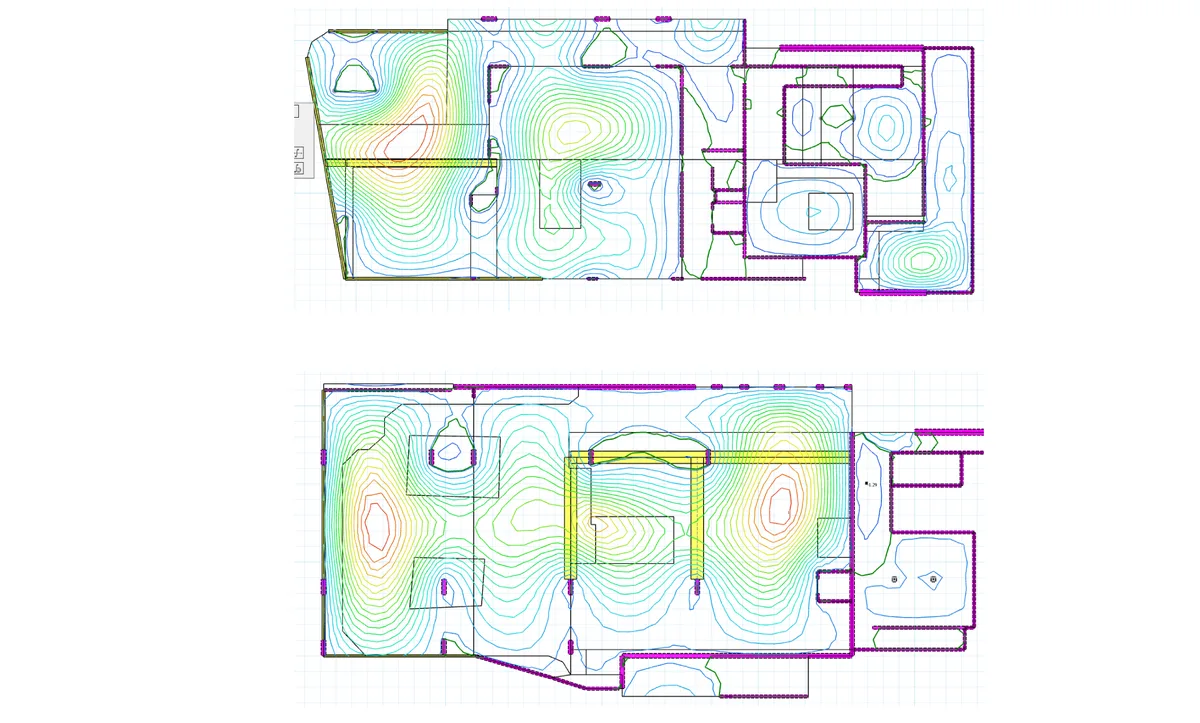
Slab deflection plans are structural engineering diagrams showing how a slab's shape changes over time. They show the regions most likely to hog and sag: hogging is upward bending, sagging is downward bending. Seeing where the slab will actually end up is what lets you design falls and outlets that still work in ten years, rather than falls that only worked on the day of the pour.
How to design a bathroom for waterproofing
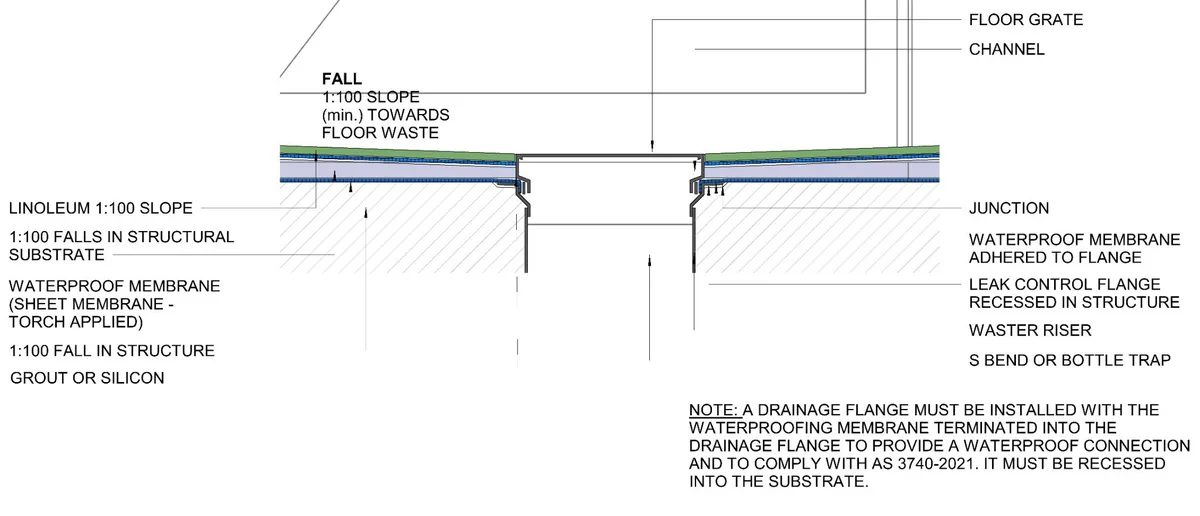
Most bathroom waterproofing problems live in the floor. Three elements do most of the work: a 50mm set down in the structural slab across the whole bathroom area, a 1:80 fall in the shower's structural substrate, and a 1:100 fall in the bathroom's structural substrate.
Assess the bathroom's slab deflection plan first to locate sagging and hogging, then work out the floor slab thickness and the required substrate falls of 1:80 and 1:100. With all of that in hand it becomes straightforward to calculate an accurate finished floor level and reduce the room for construction error. This is the let it work principle applied to the floor structure.
Sloped flooring gives water a path to the drainage zone, which is let it flow. Any water that gets through the tiling can make its way to the drain, high risk areas like wall junctions stay out of danger, and the slab itself provides a continuous barrier against water leaving at the room's perimeter.
How to design a balcony for waterproofing
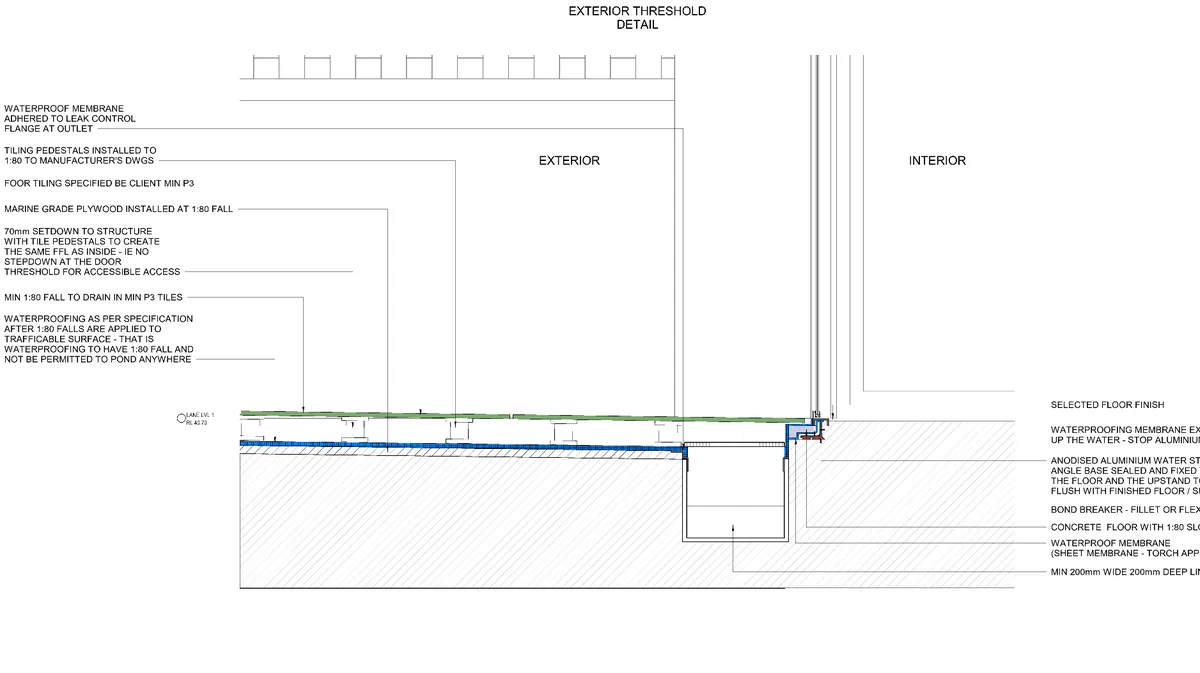
When an area is open to the weather, the placement of rainwater outlets and downpipes is critical, and it has to be decided against the slab. Find the areas of projected deflection, because they become the water channels over time, and place outlets where sagging is at its lowest.
The slab should be built with a 1:80 fall to the rainwater outlet. A 70mm set down protects the facade and stops water leaking at the wall junction. Microstrain calculations and curing procedures matter here, and shrinkage steel should be included, all of which reduces cracking and keeps the flow path to the outlet intact.
Following let it move, joints in the concrete slab must sit away from anything that gets wet. Pour joints and cold joints do not belong in balconies, and topping layers and separate pours should be avoided. Separate slabs undergo differential movement, and that movement is the leak.
How to design a podium for waterproofing
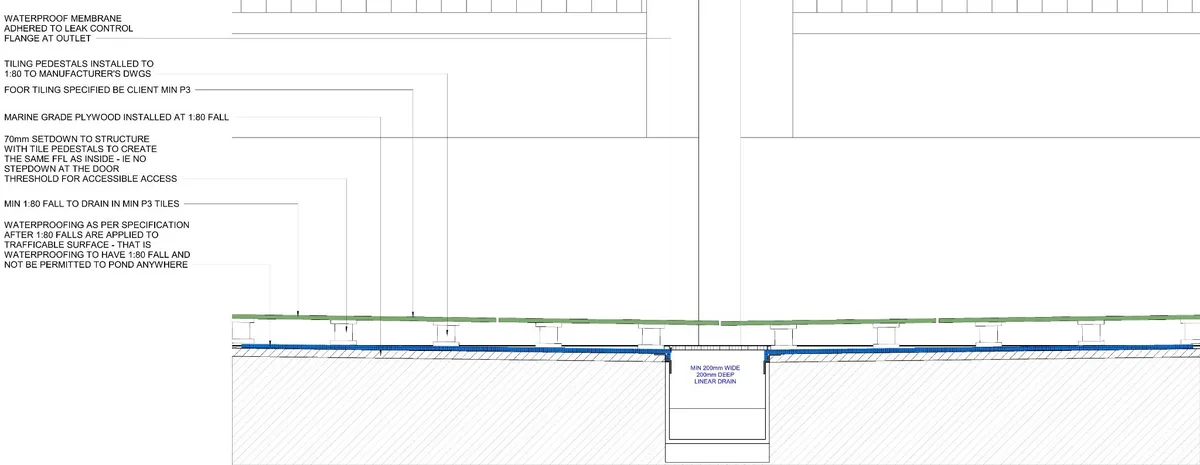
Large weather exposed slabs often cannot be poured as a single slab, so the job becomes minimising the impact of differential movement. Rainwater outlets still go at the expected low points, with a 1:80 fall from the slab joint to draw water away from the joint, and a 50mm rise cast at the joint for further protection.
The membrane should cover the slabs and run continuously across the joint, with an upward loop centred on the joint as an extra safety net. A sloped sheet metal cap provides the final layer and should be fixed to one side of the joint only, so the joint can still move. The detail spreads stress across every layer of the structure and builds in the redundancy that let it work asks for.
How to design a carpark for waterproofing
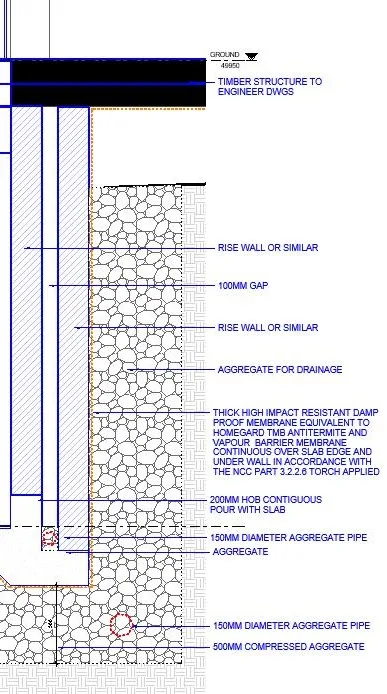
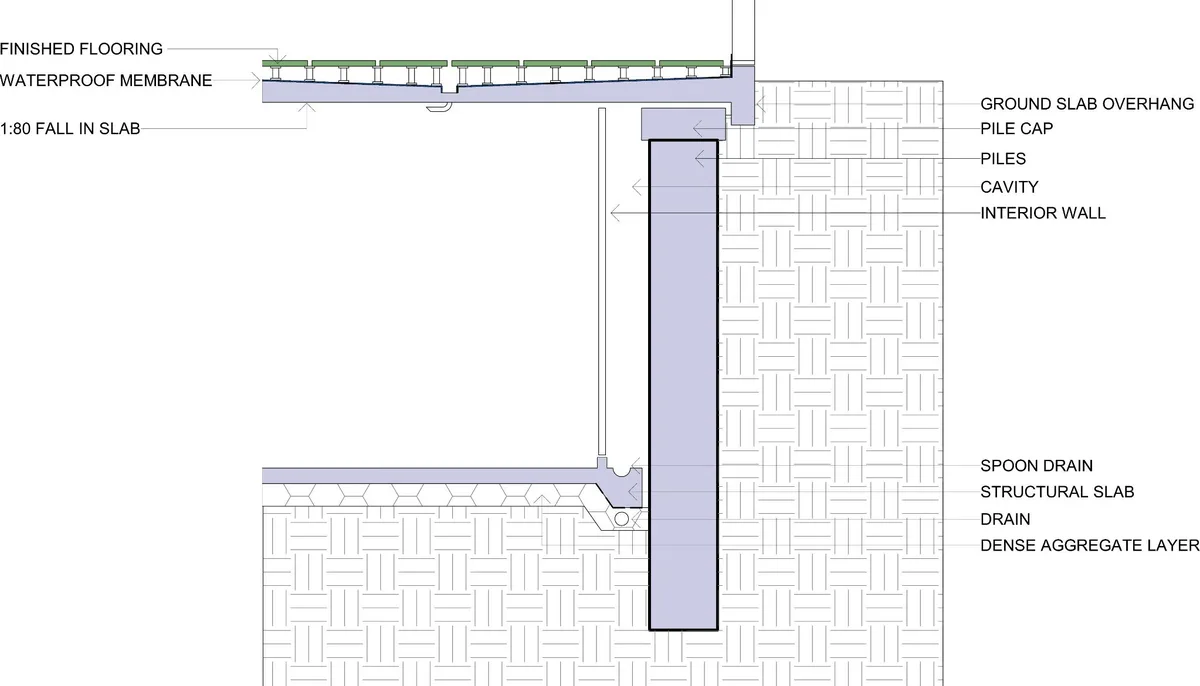
Underground carparks have an extra problem: groundwater arriving through the floor and walls. The wall structure needs a cavity, because some water will inevitably get through the outer layer. The cavity stops water bridging to the internal layer by giving gravity a capillary free space to pull it down, and a spoon drain at the bottom of the cavity collects it.
The floor has to resist water rising from the water table. Drains go at the key points, such as joints and terminations, surrounded by a dense layer of aggregate to relieve hydrostatic pressure and push water toward the drains. Where upward pressure remains, upside down drains can discharge the rest.

How to design windows for waterproofing
Windows are one of the most common waterproofing failure points in apartment buildings. Every flashing junction, sealant bead and frame profile has to do its job, and the membrane behind has to keep doing its job for decades after the sealant gives up. The two details below show how the head and sill are made to work together: flashings divert visible water, the membrane catches the rest, and a 200mm minimum upturn means a small construction error does not become a leak. Hover or tap any number to see what each component does.
The head detail is about flashing the joint at the top of the window so water sheets clear of the frame. The flashing tucks behind the new render and laps over the head of the existing window, so any water that gets past the render finds itself directed back outside.
The sill is the higher risk side. Water collecting on the sill has gravity pulling it back into the building. A continuous PVC subsill tray with 200mm upturns either side of the opening, plus an aluminium sill flashing dressing the bottom of the frame, gives the assembly two redundant water exits before the membrane behind even gets called on.
How to design retaining walls for waterproofing
Retaining walls have a constant water source on one side: soil, rain, irrigation, anything that lands on the ground above the wall. The waterproofing has to deal with that water without ever letting it pool behind the membrane, because hydrostatic pressure builds quickly and finds every weakness. The two details below show how a torch applied membrane, an aggregate drainage layer and a slotted drainage pipe work together: most of the water never touches the membrane, and what does is moving sideways toward the drain rather than pressing inward.
Detail one shows the upper section: a concrete dish drain catches sheet flow at ground level, the membrane is torch applied to the back of the blockwork, geofabric keeps the soil out of the aggregate layer, and the slotted pipe at the bottom is the relief route for everything that gets through.
Detail two shows the termination at the base: a concrete hob giving the membrane a clean termination, the aggregate layer continuing down to the same slotted pipe, everything connecting cleanly into council stormwater.
If your building is dealing with waterproofing that was never designed to these principles, that is the work I do. A Class 2 waterproofing consultation is a fixed $660 including a diagnostic site visit, and the full approach is on the waterproofing remediation service page.