 Shea CullenNSW Registered Architect 9748 · Updated 28 September 2026
Cost is the question I am asked most, and the one the industry answers worst, because almost everyone publishing numbers is selling a build. I am not a builder, so here are the figures I actually see when projects go to tender, the published numbers and why they sit lower, the costs the glossy figures leave out, and the Central Coast specifics that move the total.
One rule before any numbers: all per square metre figures are rubbery. They vary with what is counted (garages? decks? site costs?) and they age quickly. Use them to set expectations and to compare like with like, never as a quote.
The figures I see on the Central Coast
These are my own observation from projects I have tendered, not a published index. They are build cost only, so land, consultant fees and authority charges sit on top.
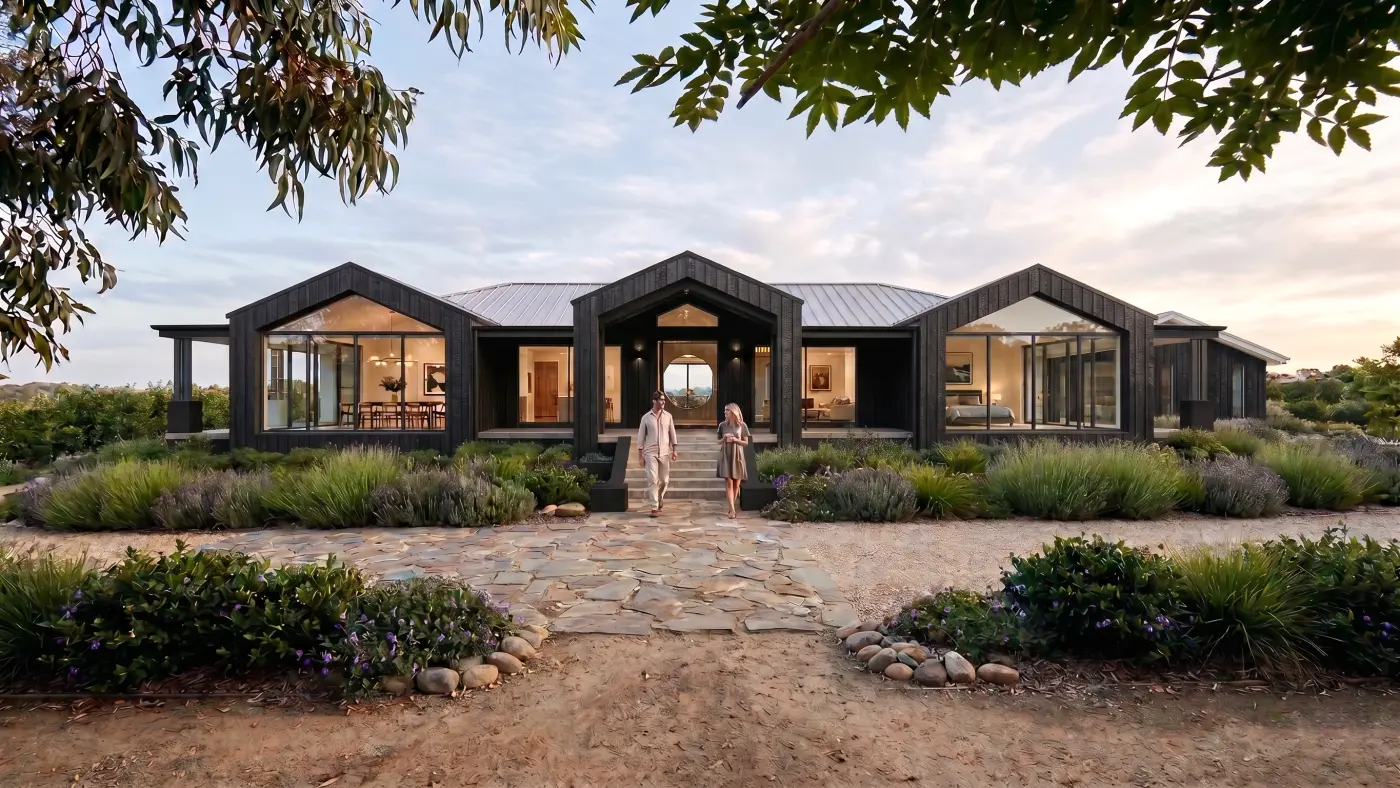
- Project and volume homes: around $3,500 to $4,500 per m².
- Architect designed homes: around $6,000 to $7,500 per m².
Both sit well above the ranges you will find in the published cost guides, and the project home figure is often the one that surprises people most, because it is the number an advertised base price is meant to represent.
If you would rather see one real project than a range, a client has let me publish every invoice from her 155m² build, from the first architect payment through to the slab. It is tracking at $3,810.56 per m² for construction to lockup, with the fitout still to come.
Why the published guides sit lower
The guides are worth knowing, if only because the builder you are talking to may be quoting them at you. Here is what they say and where the gap comes from.
- Quantity surveying guides. Duo Tax (September 2025) puts standard project homes at roughly $1,600 to $2,700 per m² and custom or luxury homes at $2,700 to $3,900+ per m². Those are GST exclusive and, in their own words, assume a straightforward site with no major earthworks, retaining or bushfire compliance. Very little of the Central Coast is a straightforward site.
- Sydney region residential. Rider Levett Bucknall's 2025 figures, as republished by a volume builder, span roughly $2,500 to $7,600 per m², with the top of the range being full custom work. The upper end is closer to what I see than the quantity surveying "custom" figure is.
- Central Coast builder pricing. Montgomery Homes, a volume builder active on the Coast and in Newcastle, published (March 2026) an indicative $2,100 to $2,600 per m² for knockdown rebuild projects, with total project ranges of $580,000 to over $1 million. Read that as a base price rather than a finished price, and see the next section for what gets added to it.
- The statewide average. Analysis of ABS approvals data for 2024-25 put the average cost of building a new house in NSW at about $558,000. It is a useful sanity check against advertised prices that sound too good, but it averages every house type in the state.
There are two reasons for the gap. The first is timing: published guides are compiled from completed work, so they describe a market that has already moved. The second is definition. Much of what those guides average in as "custom" is an upgraded project home, a catalogue plan with better finishes on a flat, easy block. A genuinely bespoke home is designed around a specific site, often a sloping or rocky coastal one, and resolved to a level of detail a catalogue never reaches.
That extra cost per square metre is also not the whole story, because a bespoke home tends to need fewer square metres. A well designed 200m² home can live like a poorly planned 260m² one.
So compare like with like. Pricing an architect designed house against a project home rate is the most common budgeting mistake I see.
Why the advertised base price is not your price
A project home base price buys the house from the catalogue on a flat, serviced, unconstrained block. The difference between that block and yours gets added back later. The usual gaps:
- Site costs. Earthworks, piering, retaining, connections. Montgomery Homes' own published guidance puts site preparation at $10,000 to $70,000 or more depending on slope, access and soil. On a knockdown rebuild, demolition adds roughly $20,000 to $55,000.
- The liveability items. Depending on the builder: driveways, flooring, window coverings, landscaping, fencing, sometimes even paint upgrades. Consumer cost guides commonly suggest allowing 20 to 30 per cent above the base price for a realistic move in figure.
- Compliance for your specific block. BASIX and the 7 star energy standard (the NSW Government's own 2023 estimate was about $7,150 added to an average new house, against roughly $1,070 a year in energy savings), plus whatever your site's overlays require.
None of this makes project homes bad value. It means the comparison point is always the finished price on your block, which is also the honest way to weigh a project home against an architect designed build.
What the Central Coast adds
- Slope. Our suburbs run up ridgelines and down to the water, and slope is the biggest single site cost driver: cut and fill, retaining, piered slabs, split levels. Industry guides put retaining walls alone at several hundred dollars per square metre of wall face. Check whether a site is too steep before you buy it.
- Rock. Hawkesbury sandstone runs close to the surface across much of the Coast, and rock excavation rates run several times soil rates. That is why a thin "excavation" provisional sum on a Coast block should worry you. The mechanism has its own explainer: provisional sums and prime cost items.
- Bushfire (BAL) construction. A bushfire prone classification adds construction requirements that scale steeply with the rating. Industry cost guides put the premium at a few thousand dollars at BAL 12.5, tens of thousands through BAL 29 and BAL 40, and potentially six figures at BAL FZ. Those amounts are indicative only.
- Flood levels. On flood affected land, habitable floors (and now parking) must sit above the minimum habitable level, which can mean suspended floors and more structure. The Flood Information Certificate that tells you your level costs $424.55 from Council (2026/27 fee schedule).
The same house costs meaningfully different amounts on different blocks, which is why pricing the build before committing to the land is step one of my checklist for buying a block on the Central Coast.
Where costs are heading
Annual growth has settled: national construction cost growth was 2.5 per cent for 2025 per Cotality's Cordell index, the smallest annual rise since 2002, against a pre-COVID decade average of 4.7 per cent. The step change of the preceding years has not reversed, though. Rider Levett Bucknall put the rise in residential building costs at about 31 per cent over the five years to mid 2025. If your budget expectations were formed before 2020, add that 31 per cent before you start.
How to budget like it will actually go
- Set the finished house budget first, then work backwards to land plus build plus buffer.
- Hold a 10 to 15 per cent contingency (the standard quantity surveyor advice), more on a sloping or constrained block.
- Get the site information early: survey, geotech, flood and bushfire layers. Finding rock at excavation stage costs far more than finding it in a geotech report.
- Interrogate allowances and exclusions in every quote before comparing totals, and know the questions to ask before signing.
- If the numbers only work with no buffer and skinny allowances, reduce the scope before you sign.
If you want a reality check on what a build is likely to cost on your specific block, send me the address and I will tell you what I see, including the site costs people forget. The rest of the journey is mapped in before you build on the Central Coast.